 English
Views: 24 Author: Site Editor Publish Time: 2025-12-18 Origin: Site


Skincare products—especially those with active ingredients like vitamin C, retinol, or hyaluronic acid—are highly susceptible to degradation from air, light, and bacteria. This is where vacuum skincare packaging shines, with the vacuum pump bottle being a star player. Unlike traditional bottles that expose contents to air every time you open them, vacuum packaging creates an airtight environment, directly addressing the root causes of product spoilage. Below, we break down how vacuum technology extends shelf life, the oxidation resistance principle of vacuum pump bottles, and the industry standards that ensure their reliability.
Vacuum packaging’s ability to prolong skincare freshness lies in its ability to isolate the product from three main spoilage factors: oxygen, contaminants, and light (when paired with opaque materials). Here’s how it works:
Oxygen Barrier: Stops Oxidation & Active Ingredient Degradation
Oxygen is the biggest enemy of many skincare ingredients. When exposed to air, vitamin C breaks down into unstable compounds (losing its brightening effect), retinol oxidizes (causing irritation instead of anti-aging benefits), and natural oils turn rancid (developing a bad smell). Vacuum packaging removes 90–95% of oxygen from the container—without oxygen, oxidation reactions can’t occur, keeping ingredients stable for 2–3 times longer than traditional packaging. For example, a vitamin C serum in a airless pump bottle can maintain its efficacy for 6 months after opening, compared to 2–3 months in a regular pump bottle.
Contaminant Prevention: Blocks Bacteria & Dust
Every time you open a traditional jar or bottle, your fingers, air, or dust introduce bacteria (like E. coli or Staphylococcus) and pollutants. These contaminants multiply in the product, leading to spoilage (e.g., mold, cloudy texture) and potential skin infections. Vacuum pump bottles use a sealed, one-way dispensing system—no air or external particles enter the bottle when you press the pump. This “no-touch” design keeps the product sterile, eliminating the risk of contamination and extending its safe use period.
Moisture Control: Maintains Texture & Consistency
Humidity in the air can alter a product’s texture—for example, making a thick cream runny or causing a powder-based exfoliant to clump. Vacuum packaging creates a low-humidity environment inside the bottle, preserving the product’s original texture and consistency. This is especially critical for water-based serums or oil-in-water emulsions, which are prone to separating when exposed to fluctuating moisture levels.
The vacuum bottle ’s anti-oxidation power comes from its unique mechanical design, which maintains a vacuum state inside the bottle throughout use. Here’s a step-by-step breakdown of its working principle:
When skincare brands fill a airless pump bottle, they first remove air from the bottle using specialized equipment, then seal the pump mechanism. This creates an initial vacuum—there’s almost no oxygen inside the bottle when you first purchase it. The bottle’s body is usually made of rigid plastic or glass, which doesn’t collapse under vacuum pressure, keeping the airless state intact.
Unlike a regular lotion pump (which draws air into the bottle to replace dispensed product), a vacuum pump uses a piston or diaphragm system. When you press the pump head, the piston moves downward, pushing product out through the nozzle. When you release the pump, the piston rises—but instead of sucking air into the bottle, it pulls a small inner liner (attached to the bottle’s bottom) upward. This liner “follows” the piston, reducing the bottle’s internal volume to match the amount of product dispensed. No air enters the bottle— the vacuum state is maintained.
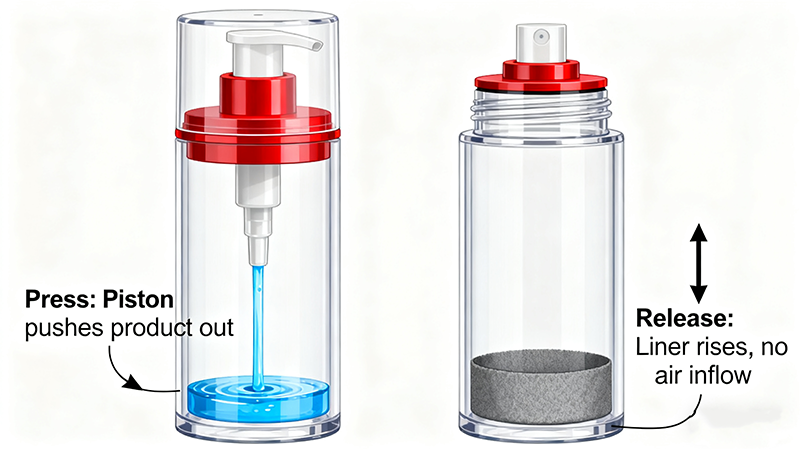
Every time you use the airless pump bottle, the inner liner moves up, ensuring there’s no empty space for air to fill. This means the product is never exposed to oxygen from the moment you open the bottle until it’s completely empty. For oxygen-sensitive ingredients like ferulic acid or coenzyme Q10, this continuous air exclusion prevents oxidation entirely, keeping the product effective until the last drop.
To ensure vacuum pump bottles meets quality and safety requirements, global regulatory bodies and industry associations have established strict standards. Key standards include:
This international standard applies to vacuum packaging for skincare products that claim “sterile” or “preservative-free” benefits. It requires that the vacuum seal remains intact for at least 12 months from the manufacturing date, with no air leakage (tested via pressure decay or helium leak detection). For vacuum pump bottle, this means the pump mechanism and inner liner must not develop leaks, even after 100+ pump presses (the average number of uses for a 30ml bottle).
Plastics must be BPA-free and meet EU REACH standards (no harmful substances like phthalates).
Rubber gaskets (used in the pump seal) must be food-grade or cosmetic-grade silicone, which doesn’t degrade or release particles into the product.This ensures the vacuum packaging itself doesn’t compromise the skincare product’s safety.
This American Society for Testing and Materials (ASTM) standard outlines methods to test a vacuum pump bottle’s ability to maintain a vacuum. Common tests include:
Pressure Decay Test: The bottle is filled with product, sealed, and pressurized. If the pressure drops by more than 5% in 24 hours, the bottle fails (indicating a leak).
Weight Loss Test: The bottle is weighed, stored for 30 days, then reweighed. A weight loss of more than 0.5% means product is leaking (via a faulty seal), failing the test.
Brands must pass these tests before launching vacuum-packaged skincare products.
Vacuum packaging technology, led by the vacuum pump bottle, revolutionizes skincare shelf life by eliminating oxygen, blocking contaminants, and maintaining product stability. Its anti-oxidation principle—creating a continuous airless environment via a piston-and-liner system—ensures active ingredients stay effective longer, while strict industry standards (like ISO 11607-1 and EU Cosmetics Regulation) guarantee safety and reliability. As skincare becomes more focused on “clean” and “effective” ingredients, the anti-oxidation skincare bottle (like vacuum pump models) will remain a key packaging solution for years to come.If you also want to keep your skin care products fresh for a long time, why not try a vacuum pump bottle? You can check out the vacuum bottle products on our website:https://www.packsubir.com. If you have any questions, you can contact us by phone 0086-574-88390029 or email samuel@subircosmetics.com.


